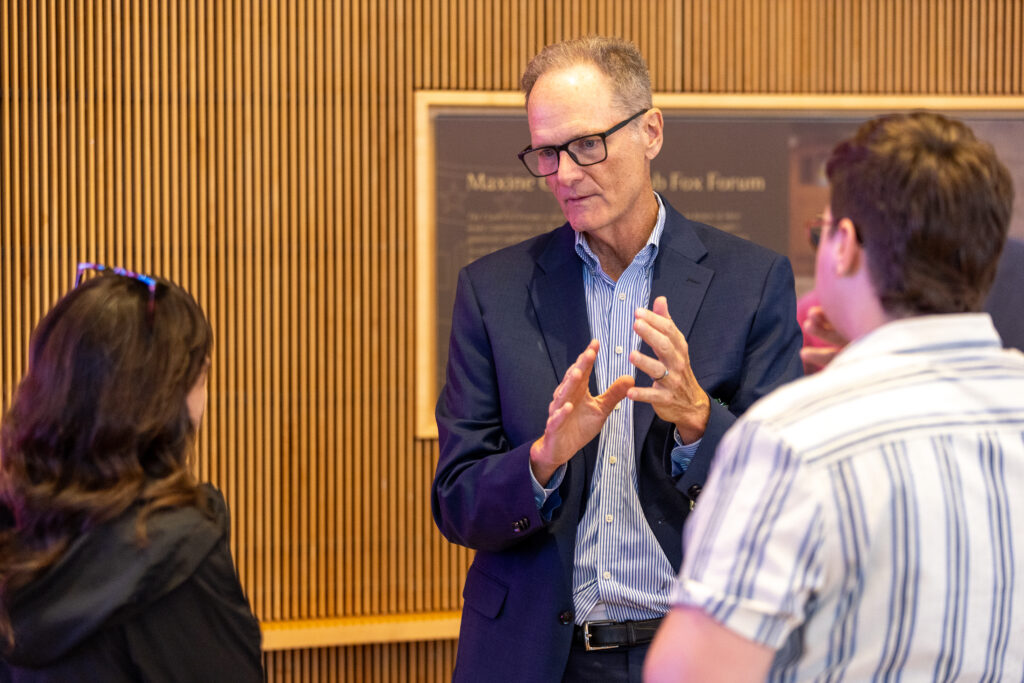
From helping formerly incarcerated students find housing and employment to guiding them through the everyday challenges of returning home, Denis Shine has spent the past five years helping people build new lives beyond prison walls as the reentry advocate for the WashU Continuing & Professional Studies (CAPS) Prison Education Project (PEP).
Now, the Missouri Department of Corrections has recognized that commitment on a statewide level, naming Shine its 2026 Non-DOC Missouri Reentry Champion of the Year. The award was announced during the virtual Missouri Reentry Conference on November 3.
“Denis has made an extraordinary difference in the lives of our students, helping them navigate some of the most difficult challenges they face as they return to their communities,” said Sean Armstrong, dean of CAPS. “This statewide recognition is well deserved and reflects the compassion, dedication and personal commitment he brings to his work every day. We’re incredibly proud of Denis and the impact he’s making through PEP.”
For Shine, the recognition is an unexpected honor in a second career that has transformed his own life as much as the lives of those he serves.
“I’m a different guy than you’d have met 20 years ago,” he said.
From corporate insurance to prison education
After three decades with FM Global, where he managed operations in St. Louis, Shine began looking for an opportunity to make a more direct contribution to his community. His interests in education and the criminal justice system led him to PEP, where he began volunteering as a tutor at the Missouri Eastern Correctional Center in Pacific approximately eight years ago.
“Pretty much every Monday morning, I’d be in Pacific in the prison, helping students work on their papers and maybe some math,” Shine recalled.
The experience inspired him to pursue a master’s degree in social work from WashU’s Brown School. Five years ago, he joined PEP as its reentry advocate, helping students prepare for life after incarceration.
His work begins by asking students what they want for their futures.
“You’ve been told for 10, 20, some 30 years what to do,” Shine said. “And I don’t do that. I say, what do you want?”
Working together, Shine and PEP students would develop plans addressing housing, employment, identification, health insurance and other essential needs. Shine also helps students continue their education, coordinates workshops on practical life skills and builds relationships with community organizations that provide reentry services.
His support doesn’t end when students leave the facilities where PEP offers classes. Shine follows students who are transferred to other prisons, visits them as they prepare for release and sometimes picks them up on the day they return to their communities.
Sometimes, Shine’s support means addressing needs others might overlook.
“You can’t operate in this world without a phone,” Shine said, recalling a student who was released on a Friday with no phone and no one to contact. The experience prompted PEP to develop a phone program where a partnership with the WashU student organization Heart for the Unhoused led to the development of Tech Buddies. These are volunteers helping students adjust to smartphones and computers after years of incarceration.
Overcoming barriers and building new lives
Beyond adapting to new technology, returning students face even greater challenges securing housing and employment. Shine recalled working with a former student who had enough money to rent an apartment but was rejected by 31 properties because of his criminal record before finding housing on the 32nd attempt.
Employment can be equally challenging. Shine encourages students to recognize that building a career often takes time, particularly when a criminal record can prevent otherwise qualified applicants from getting an interview.
“A job, a better job, and then a career,” he said. “That’s the way it’s worked out.”
He has seen former PEP students start businesses, pursue advanced degrees and build careers in fields ranging from technology to community advocacy.
Since Shine began his reentry work, he estimates that approximately 50 PEP students have been released. According to Shine, none has returned to prison on new criminal charges.
For Shine, the greatest rewards come from watching students work through difficulties and establish stable lives. But those experiences have also challenged his own assumptions about resilience and what it means to overcome adversity.
He recalled feeling bad for a former student who faced a 90-minute bus ride each day to access a resource he needed. The student saw the situation differently.
“Denis, I was locked up for 19 years. What do I care about an hour and a half bus ride?” the student told him.
It’s an attitude Shine has encountered repeatedly among students who have faced circumstances far different from his own.
He often references a lesson from Robin Boda of Hope Education: “I have something to learn” and “I have something to teach.”
“I think that’s the way I look at my job because I learned from these guys,” Shine said. “I’m a changed guy because I’ve been involved in their lives over the last five, six, seven years.”
Rather than approaching his work with all the answers, Shine draws on the experiences of former students to help those preparing for release.
“I actually think a lot of what I do with our clients is just be someone who cares and listens,” Shine said. “I take what I’ve learned from my previous clients and tell the next ones.”
He’s also struck by how often former students want to help others facing the same challenges.
“Most of my folks who get out, they want to help,” Shine said. “I have to tell them, right now, take care of yourself. I know you’re going to give back later. And they do.”
That willingness to help has become one of the most meaningful parts of his work, reinforcing how much he has learned from people whose lives and experiences differ from his own.
Creating opportunities beyond prison walls
Despite the progress Shine has seen, housing and employment remain significant obstacles for people returning to their communities. He hopes more landlords and business owners will consider providing opportunities to PEP graduates who are working to establish stable lives.
“I would love it if there were more people out there willing to help with housing and jobs for our guys getting out,” Shine said. “When they first get out, they just need a basic job and they’re willing to work.”
For Shine, the goal isn’t charity. It’s connecting people who are ready to work and contribute with employers and property owners willing to give them a chance.
“That’s the biggest thing I want,” Shine said, “is people to say I want to help.”
Landlords and employers interested in supporting PEP students as they transition back into their communities can contact Denis Shine at denisshine@wustl.edu or 314-935-3425.