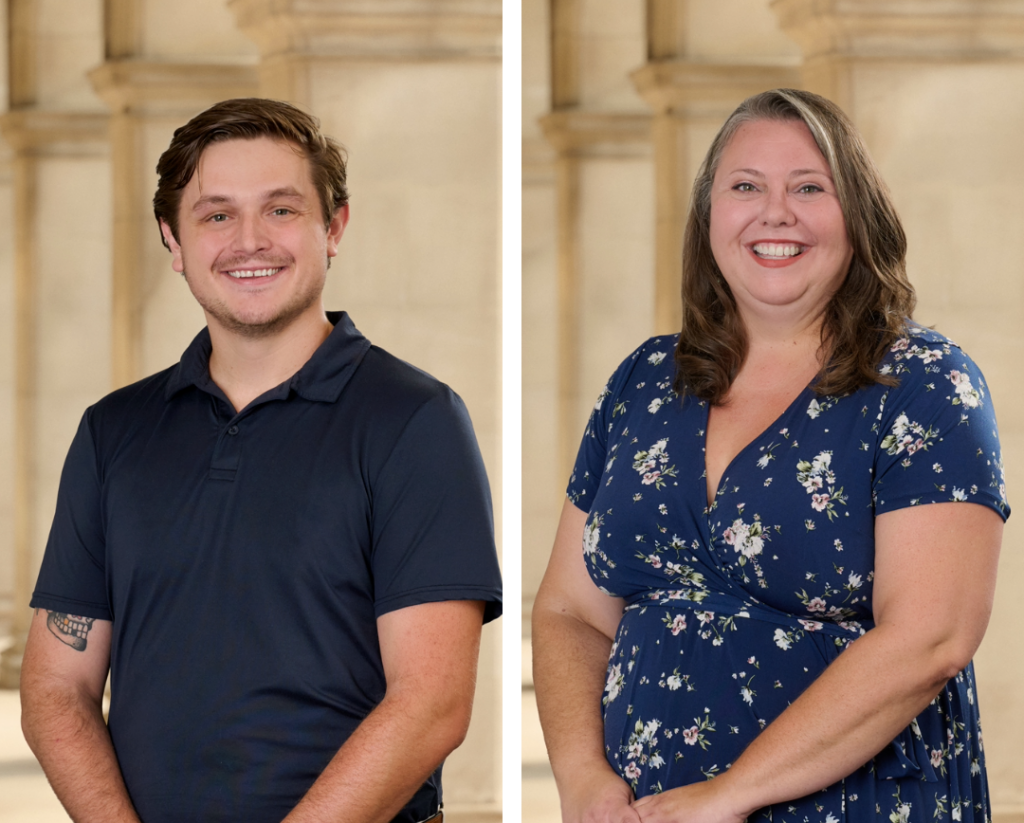
While many educators spend the summer preparing for the next academic year, two members of the WashU Continuing & Professional Studies (CAPS) instructional design team are helping shape the future of teaching itself.
This July, CAPS Instructional Specialists Cole Palmer and Kella Thornton published an article in Faculty Focus highlighting an innovative WashU program that empowers adjunct faculty to improve the student experience through the Marion Horstmann Online Teaching Innovation Grant. Just months earlier, the pair volunteered with WashU’s Institute for School Partnerships (ISP), mentoring middle school educators as they introduced innovative technology into classrooms across the St. Louis region.
Although the two efforts served different audiences, they were driven by the same goal: supporting educators so they can better support students.
“Education doesn’t improve through individual effort alone,” said Dean Sean Armstrong. “It improves when educators invest in one another, share ideas across disciplines and grade levels, and continually look for new ways to better serve students. Cole and Kella embody that spirit through both their scholarship and their service, extending WashU Continuing & Professional Studies’ commitment to innovation well beyond our classrooms and into schools across the St. Louis region.”
Recognizing Innovation Where It’s Often Overlooked
Their recently published Faculty Focus article examines the Horstmann Grant, a WashU CAPS initiative that provides funding for adjunct faculty to develop innovative teaching projects.
For Thornton, what makes the grant remarkable isn’t simply the funding—it’s who it supports.
“I have never seen a faculty program quite like this, one that actually prioritizes the development of part-time or contingent faculty,” Thornton said.
Unlike many faculty development programs tied to tenure or research expectations, the Horstmann Grant encourages instructors to invest significant time in improving their teaching because they believe it will create a better learning experience for students.
“It’s really amazing to see instructors who are interested in this kind of development for the love of the game,” Thornton said. “They don’t have to do this. They don’t need to do this. This is extra time and effort on their end, but they want to develop because they care so deeply about CAPS students.”
For Palmer, that dedication was one of the clearest takeaways from the research.
“Most of our faculty have other jobs and other commitments, and they’re taking on this work because they want to improve their craft and improve the student experience,” Palmer said. “That speaks volumes about the instructors we have at CAPS.”
Looking Beyond Technology
While many conversations about innovation center on artificial intelligence or new digital tools, Palmer and Thornton found that meaningful innovation often begins with teaching itself.
Thornton believes innovation is often misunderstood.
“Sometimes people equate innovation to the use of educational technology,” she said. “What we’re really looking for is how instructors are fostering innovation in a course they’ve taught and want to make even better. Innovation can be a teaching practice. It can be teaching practice plus educational technology. It can be lots of different things.”
The research also helped strengthen the Horstmann Grant itself.
Survey responses highlighted the significant time commitment faculty invest in their projects while confirming that participants overwhelmingly found the experience worthwhile. Those findings have already informed improvements to the grant’s application process, participant support, and program evaluation.
As Thornton reflected, meaningful professional growth rarely comes without some discomfort.
“To grow, sometimes it requires a little bit of growing pains,” she said. “But in the end, it was really beneficial to their students, to their teaching practice and to their development as an instructor.”
How Inter-level Collaboration Empowers Educators
While the article focused on supporting higher education instructors, Palmer and Thornton spent the spring putting those same principles into practice through WashU’s Institute for School Partnerships (ISP).
Serving as instructional coaches for middle school educators participating in an AT&T-supported innovation initiative, they worked with teachers from schools across the St. Louis region as they planned, implemented, and reflected on technology-rich classroom projects. The participating educators represented a variety of disciplines, including Spanish and Mandarin immersion, mathematics, physical education, counseling, and gifted education programs.
Rather than prescribing solutions, Palmer and Thornton served as thought partners—asking questions, offering feedback, and helping teachers adapt new tools to meet the unique needs of their students.
Returning to work with middle school educators was especially meaningful for both Palmer and Thornton, who began their careers in K–12 education.
“I was very excited both for what I could give, but also for what I could learn,” she said. “K–12 educators are really the vanguard of innovation in terms of how they use AI. I think we as college educators can learn a lot from our K–12 colleagues.”
Supporting Modern Learners
For both instructional designers, the connections between K–12 and higher education continue long after their participation in the program ends. The experiences have already influenced conversations about faculty innovation at CAPS, particularly as instructors explore new approaches to teaching and learning. The experience also reshaped how Thornton thinks about today’s students.
“We love talking about modern learners, but we don’t always know what modern learners’ experiences have been,” she said. “We’re getting a more nuanced, more comprehensive look at what these learners are coming to CAPS with. If we’re not prepared for them, ultimately we won’t meet our mission.”
For Thornton, both the Faculty Focus article and the ISP work ultimately point to the same conclusion.
“If you’re not pouring into teachers, then how do we have an institution,?” she questioned. “We don’t have an institution without students. We don’t have an institution without teachers.”
Palmer sees that responsibility extending beyond any one classroom or educational setting.
“Our job is to advocate for and support education,” he said, “however and wherever it can be given.”
Whether mentoring CAPS adjunct faculty through innovative teaching grants or coaching middle school educators across the region, Palmer and Thornton are advancing the same goal: empowering teachers with the tools, confidence, and support they need to create meaningful learning experiences for every student they serve.
In doing so, they are helping strengthen education not only at WashU Continuing & Professional Studies, but throughout the St. Louis community.