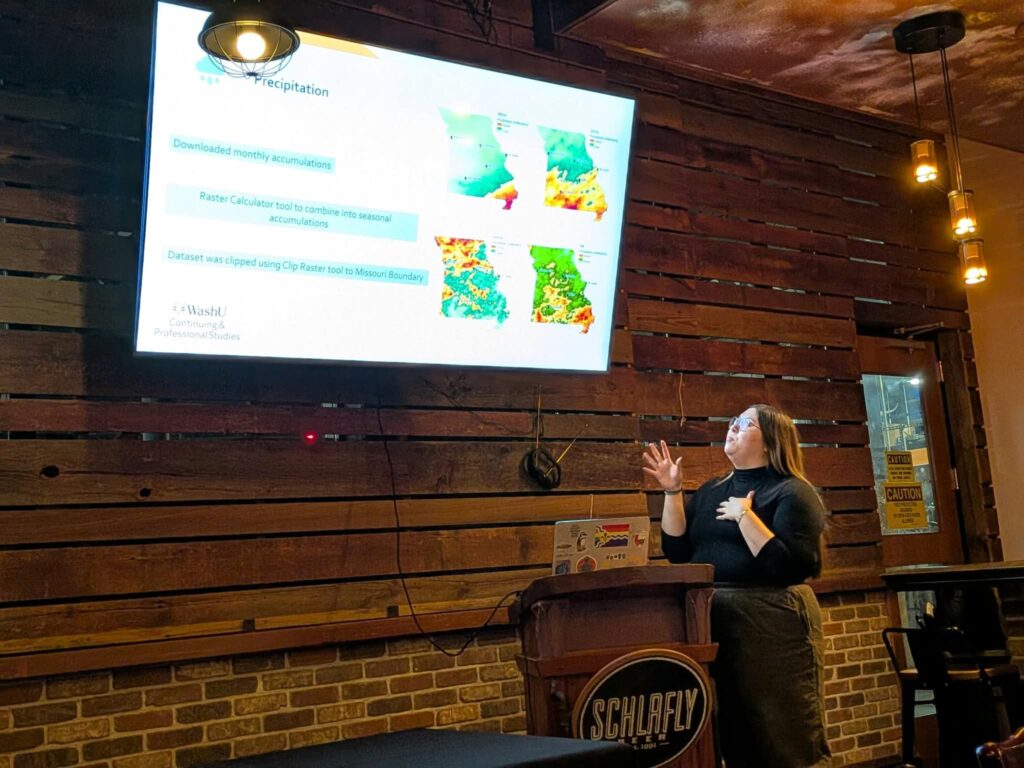
When Hannah Quon began her capstone project for the Geographic Information Systems (GIS) certificate program at WashU Continuing & Professional Studies (CAPS), she wanted to put her skills to work on something that would benefit her community.
“I have a particular interest in population dynamics and conservation and wanted to do something that contributed to my local community,” said Quon, who completed her GIS certificate in August 2026.
Through a friend, Quon connected with the Missouri Mycological Society (MOMS), an organization dedicated to studying and documenting fungi throughout the state. Working with MOMS research committee chair Mike Snyder, she developed a project exploring how environmental conditions relate to the distribution of mushrooms across Missouri.
Quon used data from the MycoMap MO Network, a citizen-science initiative that collects fungal specimens for DNA sequencing through Mycota Lab, a nonprofit laboratory in Michigan. The resulting data helps researchers identify species, document biodiversity and potentially discover previously unidentified species.
Using ArcGIS Pro, Quon analyzed 1,857 observations from a study period spanning December 2024 through November 2025, comparing the data with environmental factors including elevation, slope, precipitation and land cover.
Her analysis revealed several patterns. Approximately 71% of observations occurred in deciduous forests, while summer accounted for the largest share of recorded specimens. She also identified differences in how fungal genera were distributed across elevations and seasons.
The highest concentration of recorded observations was in a mapped area of southern Missouri that includes Christian County, Busiek State Forest and Wildlife Area and part of Mark Twain National Forest. The area accounted for 396 observations, or approximately 21% of the dataset.
But one of the project’s most important findings came from examining what the data might be missing.
“Many of the potential trends we were seeing in the available observational data could very well be attributed to collector bias,” Quon explained, noting that participants may repeatedly collect specimens from particular locations or favor certain types of mushrooms.
This raised questions about whether the available observations accurately represent Missouri’s fungal biodiversity and prompted discussions about expanding collection efforts and encouraging participants to submit a broader range of specimens.
“Our members loved Hannah’s presentation! It was eye-opening to see how collector bias affects our understanding of fungal distribution,” said Peggy Green, president of MOMS, who invited Quon to present her findings at a meeting of the society’s St. Louis chapter. “We realized there are huge areas of Missouri, particularly in the northern part of the state, where we have very few collections. Her findings have prompted our Research Committee to begin developing a strategy to address those gaps.”
Green said the collaboration also demonstrated the value of connecting community organizations with students who bring specialized technical skills.
“MOMS members collect and document thousands of fungal specimens, but we don’t always have the technical expertise to fully analyze that data,” Green said. “Students like Hannah bring new tools, skills, and perspectives, while we provide real-world data and opportunities for meaningful research.”
Sean Armstrong, dean of CAPS, reflected on the work, stating, “Hannah’s project is a great example of how students can take what they’re learning at CAPS and apply it to real challenges in their communities. Her work didn’t just help the Missouri Mycological Society better understand its data. It raised important questions that are already shaping how the organization approaches future research. That’s exactly the kind of experience – and community impact – we want our students to have.”
For Quon, the experience demonstrated how GIS can help organizations better understand their data and identify opportunities for future research. It also reflected the practical, community-focused learning opportunities available through the WashU CAPS GIS certificate program.
What began as a capstone project became a contribution to an ongoing scientific effort, helping MOMS identify new questions and consider how future research could provide a more complete picture of Missouri’s fungal biodiversity.