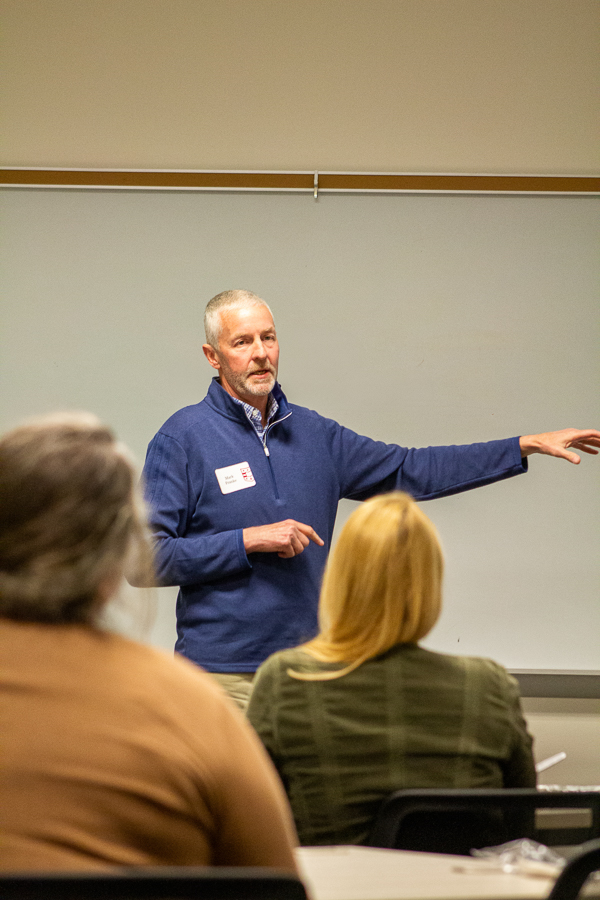
When Mark Franke talks with students in WashU Continuing & Professional Studies (CAPS) Prison Education Project (PEP) about their plans for the future, he often hears big ideas.
Some envision starting businesses. Others are thinking about opportunities they might create with family members or career paths outside a traditional 9-to-5 job.
Franke wants to help students understand what it takes to turn those ideas into something sustainable. He is working with CAPS to pilot a new three-session workshop at the Women’s Eastern Reception, Diagnostic and Correctional Center (WERDCC) in Vandalia, Missouri.
The workshop, The Business Blueprint: Lessons in Leadership, Strategy, Marketing & Operations Management, will introduce students to six interconnected areas of business.
Competencies range from building effective teams and developing strategy to understanding finance and the role of technology. The goal is to give students a playbook they can continue to use.
“What do I need to do today, tomorrow, the next day?” Franke said, recalling a similar conversation with a PEP student preparing for release. “I kind of have that in the back of my mind, too, that this is something that they can take with them post-incarceration.”
“PEP has always been about creating meaningful educational opportunities for students,” said Sean Armstrong, dean of CAPS. “This pilot gives us another way to build on that work by helping students connect what they are learning with the ideas, goals and opportunities they are considering for their futures.”
Connecting education to what comes next
Research on higher education in prison has increasingly looked beyond academic achievement and recidivism to outcomes such as employment, continued education and civic engagement. The Institute for Higher Education Policy also identifies soft skill development as an important measure of student success in higher education in prison programs.
That research helped inform the thinking behind PEP’s pilot: earning a degree can create opportunities, but students can also benefit from developing the interpersonal and professional skills needed to navigate the workplace and turn ideas into plans.
Franke and PEP leadership began discussing the realities students may face when they leave prison, including barriers to traditional employment and the possibility that some may pursue entrepreneurship or other opportunities.
“A lot of individuals have this idea they want to start their own business, or they want to create something with family members,” Franke said. “It might be more non-traditional types of opportunities where barriers might be a bit lower.”
The question became what PEP could provide alongside its academic programs to help students prepare for those possibilities.
Building the blueprint
The resulting workshop takes students through six areas that Franke sees as interconnected pieces of building and sustaining an organization.
The first session focuses on leadership and strategy, from building a high-performance culture to creating a market-focused strategic plan. In the second session, students will explore marketing and operations, including developing a customer-centric marketing plan and turning strategy into operational reality. The final session covers finance and technology, introducing the foundations of business finance and how digital transformation can drive growth.
Rather than treating each subject in isolation, Franke wants students to understand how the pieces work together.
“It starts to paint the picture that all these things tend to tie together and tend to matter in terms of how one impacts the other,” Franke said.
That broader view is especially important for students considering entrepreneurship. Building a successful business requires more than a good idea. It means understanding customers, developing a strategy, managing resources and building a team that can carry out the plan.
Sustainable skills
The skills underlying the workshop extend beyond entrepreneurship.
Recent workforce research published in Nature Human Behaviour found that broad skills such as communication and problem-solving provide a foundation for more specialized professional skills. The research also found that managerial and social skills remain important as workers progress into more specialized roles.
For Franke, more than two decades working in the technology industry reinforced the importance of those skills.
“It still comes down to people, and it still comes down to being able to build teams that work well together,” Franke said, “Teams that can accomplish goals, and teams that can get back up when they fall down.”
That remains true even as artificial intelligence and other emerging technologies change how people work.
“I don’t think it replaces the human side of what it’s like to build a team and have a culture and have all those things that really make the difference between companies that win or lose,” Franke said.
Turning an idea into a plan
Franke has seen the enthusiasm PEP students bring to conversations about their futures. A student might talk about opening a coffee shop and already be thinking about the menu, furniture or colors on the walls.
Franke wants students to keep that excitement while also understanding what must happen before those details become reality.
“There’s a lot of work that’s got to be done ahead of those aspects,” he said.
Success for the pilot, Franke said, would mean students leave with a clearer understanding of that larger picture.
“I want to get out of this that they leave with a broader viewpoint that this is the path I’m going to choose, there’s a lot more to it than maybe I thought,” he said. “There’s a lot of hard work and a lot of rigor and discipline to make that dream happen for me.”
The Vandalia workshop is a pilot. Based on student feedback and what PEP learns from the three sessions, Franke sees opportunities to refine the program, bring it to students at the Missouri Eastern Correctional Center (MECC) in Pacific, Missouri and potentially develop additional modules.
“I’m excited for it, and I think we’ll get some good feedback from the students as we work through the program,” Franke said. “I think it’s a good baseline to see how we do, and then we go from there.”