Finding the time, resources, and support to extend and deepen one’s teaching practice can be challenging. There are, after all, only so many hours in an instructor’s day.
“The Horstmann Grant afforded me the opportunity to focus for a semester,” said Sarah Chavez, PhD, a long-standing WashU Continuing & Professional Studies (CAPS) biology instructor and assistant director of community outreach and engagement (COE) at the Alvin J. Siteman Cancer Center.
During the ninth annual CAPS Faculty Show and Share in April, Chavez shared, “I had attended trainings for NotebookLM and JoVE, but I never had the time to build it into my classroom. Seeing how frequently my students ask about how to study made it clear that there was an interest in tools like this. Something that could fit their schedule and allow them to ask questions outside normal class hours.”
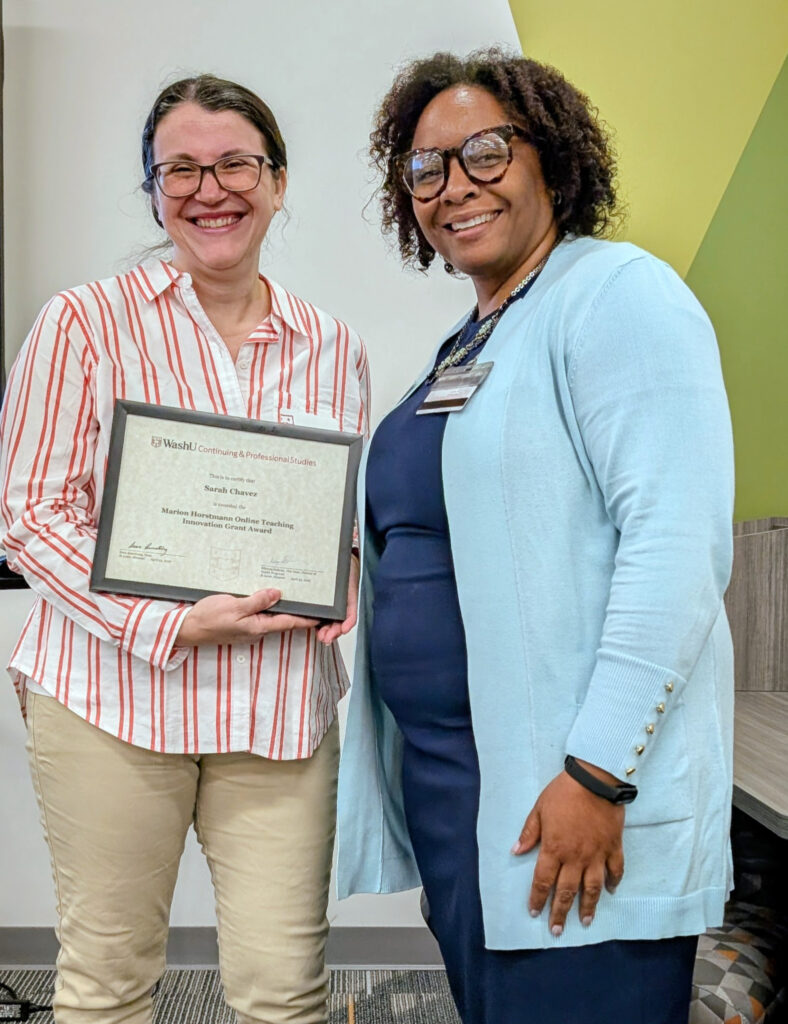
Since 2017, the CAPS Vice Dean, Dr. Kilinyaa Cothran, and the Instructional Design team, led by Dr. Lindsay Meador, Accreditation and Senior Program Manager, annually recognize one part-time instructor who proposes and delivers a plan to pioneer a new teaching practice via the Marion G. Horstmann Online Teaching Innovation Grant.
Applications open April 1 each year, and instructors who are awarded this grant must have taught at CAPS for at least two semesters. A key component of winning the $5,000 grant includes the instructor’s presentation of their work to colleagues. During the annual CAPS Faculty Show and Share, grant awardees reflect on their key learnings during a two-hour celebration of the Horstmann winner’s project while sharing what makes the CAPS teaching and learning community special.
Leveraging AI in Instruction: Sarah Chavez’s Virtual Biology Tutoring Resource
Chavez’s winning grant proposal for 2025-26, “CAPS Virtual Biology Tutoring Resource,” sought to leverage the curated use of AI through Google NotebookLM, an AI-powered research and note-taking assistant which uses the Gemini model to add meaning to vetted and user-uploaded sources, and JoVE, a PhD-reviewed science video library, as an opportunity to meet students’ need for support beyond class time.
During the Faculty Show and Share, Chavez shared how she created her first draft of her virtual tutoring resource in Canvas, CAPS’ Learning Management System (LMS) and stated her hopes the tutoring resource will continue to be used by future and past students.
“I am always in awe of our students,” Chavez said. “They are balancing careers and families and coursework, but they have that drive and strength to pursue their education and never stop learning. It’s easy to get frustrated when life gets in the way, but I think all of my fellow instructors agree that we want to see our students succeed, and we are honored to be a small part of their journey as they take this next step in their career and personal development.”
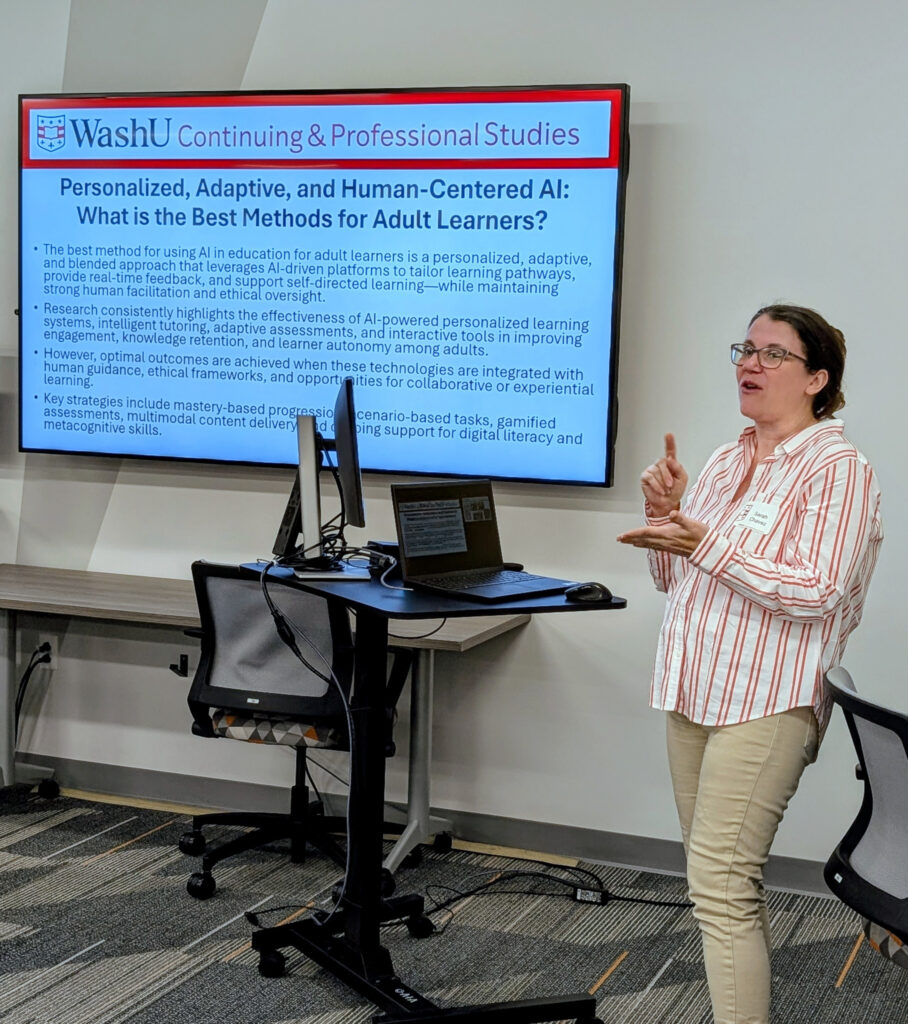
Chavez also looks forward to seeing how her Horstmann grant project evolves and serves future students, as well as inspiring other instructors to “hopefully replicate this format with additional topics or copy these resources within their Canvas pages as well.”
How Authentic Assessment Engages Modern Learners: Janiene Santos’ Semester-Long Public Relations Project
When Janiene Santos, PhD, first started teaching at CAPS in Fall 2025, she first met with Joe Cruz, PhD, academic director of management and organizational change, to brainstorm thoughtful ways to engage her “Public Relations Principles and Practices” students. As a communication expert with over two decades worth of experience in teaching and adult education, Santos knew she wanted to inspire her students to practice and refine hands-on skills in a collaborative, online class.
“Real‑world projects don’t come with tidy, predetermined answers — and that’s the point,” Santos said. “Sometimes, as instructors, we have to conduct additional research alongside our students to better guide them. It requires a willingness to be vulnerable, to admit when we don’t know something immediately, and to model how professionals navigate uncertainty. Authentic assessment invites us to learn from our students just as much as they learn from us, and the outcomes are always richer because of that shared exploration.”
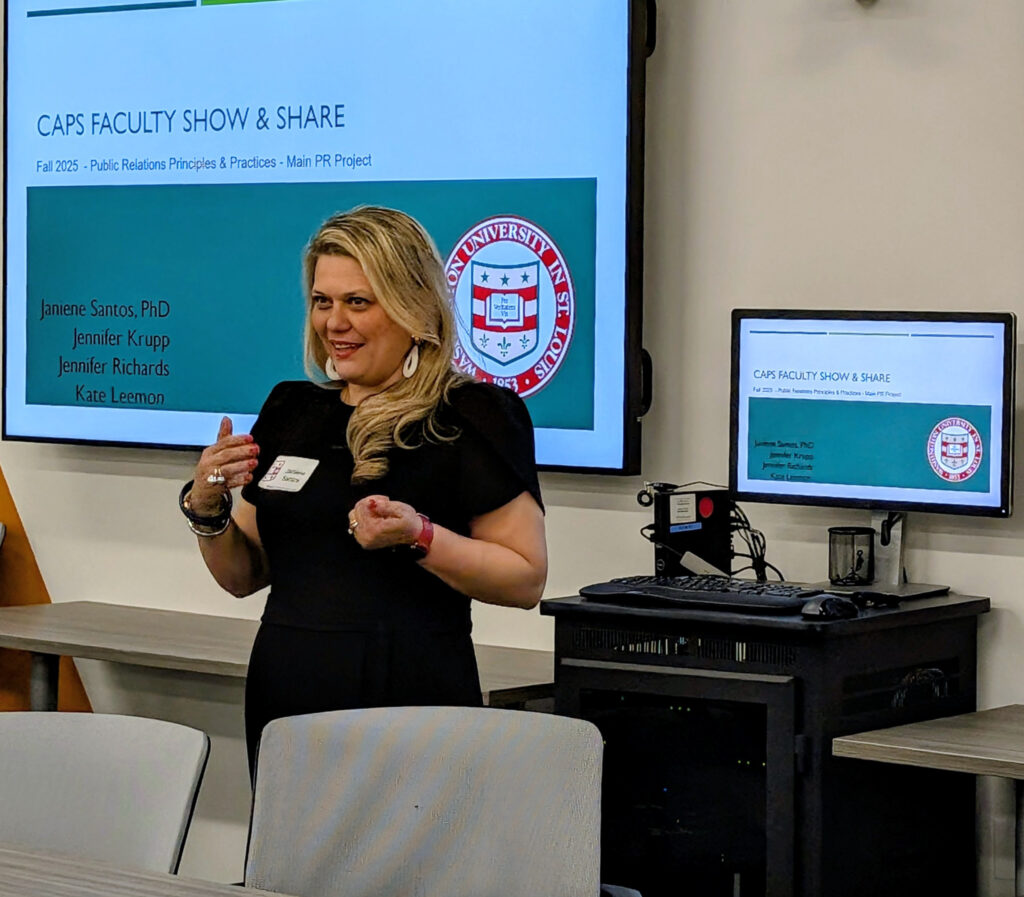
To showcase what students learned, Santos invited three of her students to share their end-of-course presentations to this year’s Faculty Show and Share audience.
The students, Jennifer Krupp, assistant director of career development at WashU’s Center for Career Engagement; Jennifer Richards, PhD, business development associate for WashU’s Office of Technology Management/Tech Transfer; and Kate Leemon, playwright, shared how they worked together within their respective groups to design purposeful communication plans and rebrands for clients such as St. Louis County Pet Adoption Center and Ralph Lauren.
“The course took theory and made me and the team put all of it into practice,” Krupp said, “because each class included time for the teams to work on the assignment, including feedback from the professor, we felt confident going into the next week that we would be successful in implementing the assignment.”
In fact, Leemon said one of the best practices she learned in Santos’ class, which she applies in her current role a semester later, is the importance of checking in with and listening to the community she serves.
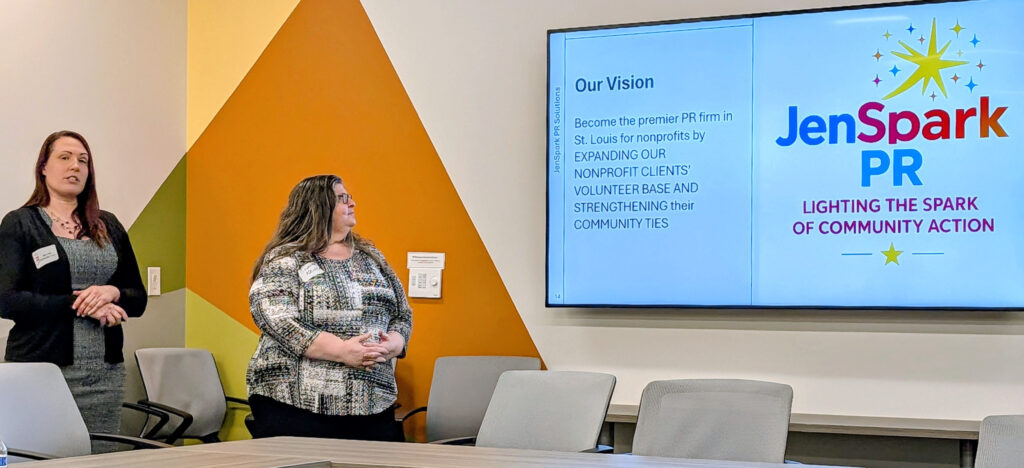
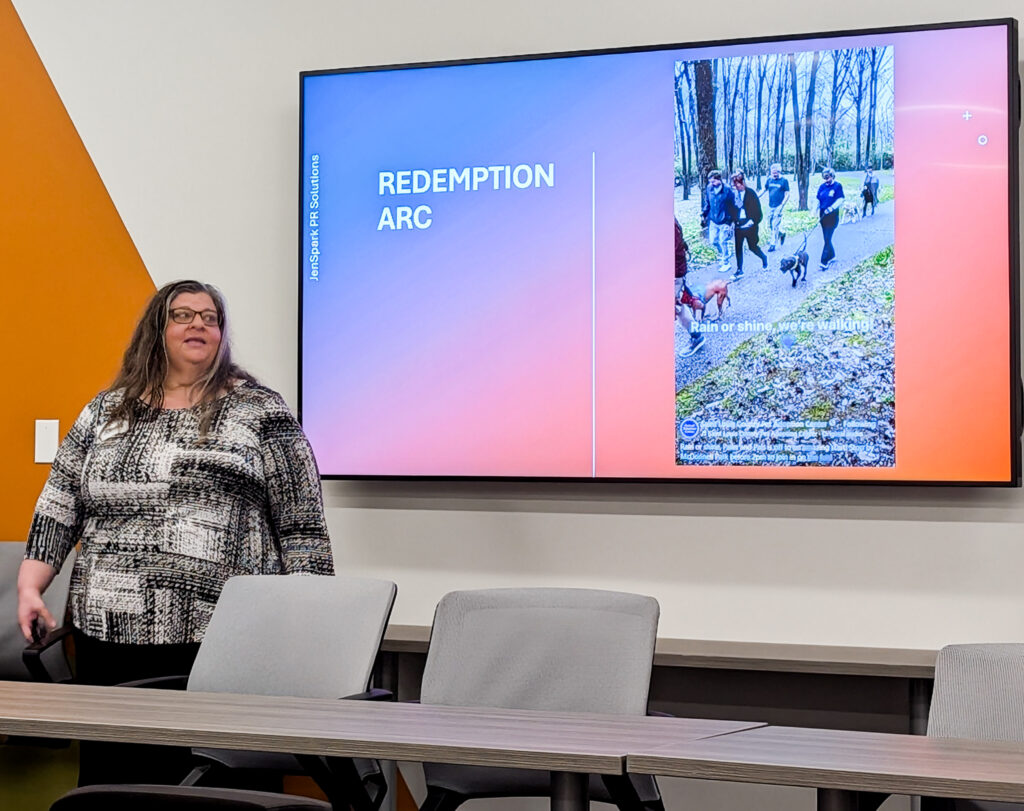
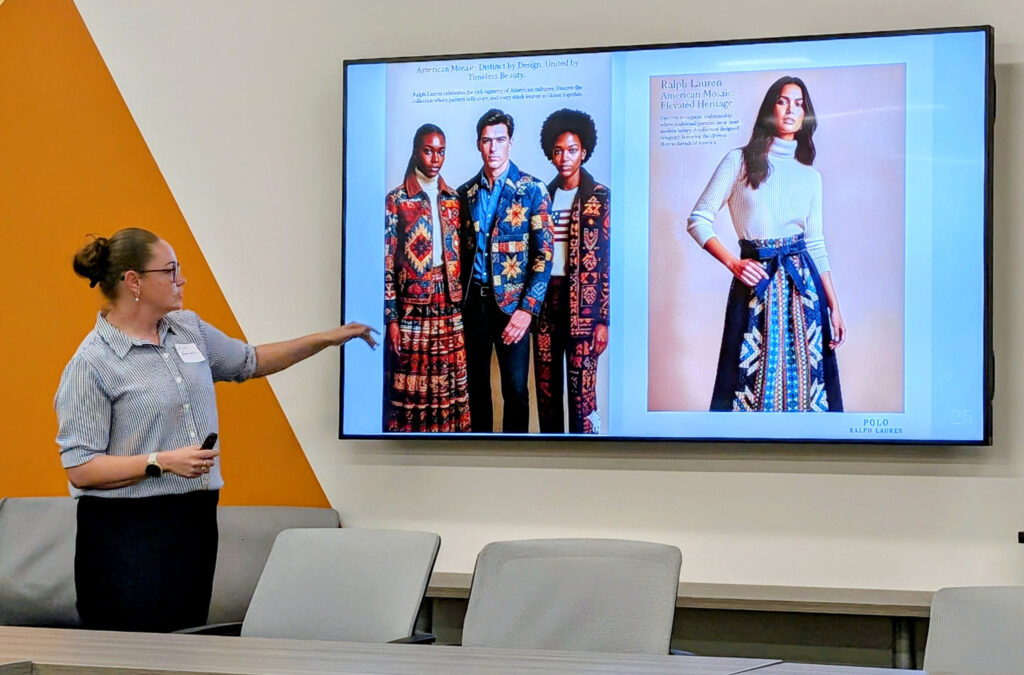
“Most importantly is to survey and react to each public or community individually,” Leemon said. “The public is not just an amorphous thing but can be different for every industry and business within that industry. Likewise, when the people in the community change, so do their responses.”
The Importance of Fostering Collaboration and Collegiality Each Spring
To see Santos’ students take a semester-long project and run with it also inspired Horstmann Grant winner Chavez to ask if future students Santos teaches might pair up with Chavez in the future to create a marketing campaign to encourage adults to receive timely health checkups, such as screening for colorectal cancer.
“Framing [Chavez’s] project as a client‑based challenge would give students the opportunity to work on a meaningful, community‑focused campaign with real impact,” Santos said. “I’m confident CAPS students would be fully engaged in developing strategic communication solutions for an issue as important as helping adults take proactive steps in their own health.”
Making interdisciplinary connections like the one Chavez and Santos made at this April’s Faculty Show and Share is one of the many reasons this event is so impactful to those who participate and attend.
“It would be amazing to share a real-world experience that impacts our WashU community as a whole and show how students with different skillsets and expertise can work together to bridge the gap,” said Chavez. “Science can be intimidating and scientists want to help, but it’s hard to know how that message will resonate with non-scientists. This is a great chance for us to reflect on how we communicate science to the general public, but also to show the importance of being open to collaborations across disciplines when the opportunity presents itself.”
This possible collaboration resonated with the students in attendance, too.
“What I always find exciting and refreshing at any CAPS event I’ve been to is how invested the faculty members are,” Leemon said. “They are always asking and reaching for more opportunities for students and each other. It is so refreshing to see the passion and drive up close.”
Celebrating instructors who motivate and guide CAPS learners is one of the many reasons participants come together each spring — to build and celebrate community, share innovative teaching and learning wins, and to learn from one another in the process.
“CAPS shows that education is not one-size-fits-all,” Chavez said. “Students learn at different paces and bring with them a wealth of life experiences. Educators in CAPS try to keep up with our respective industries to ensure we are teaching the students the material but also preparing them to be our colleagues someday.”